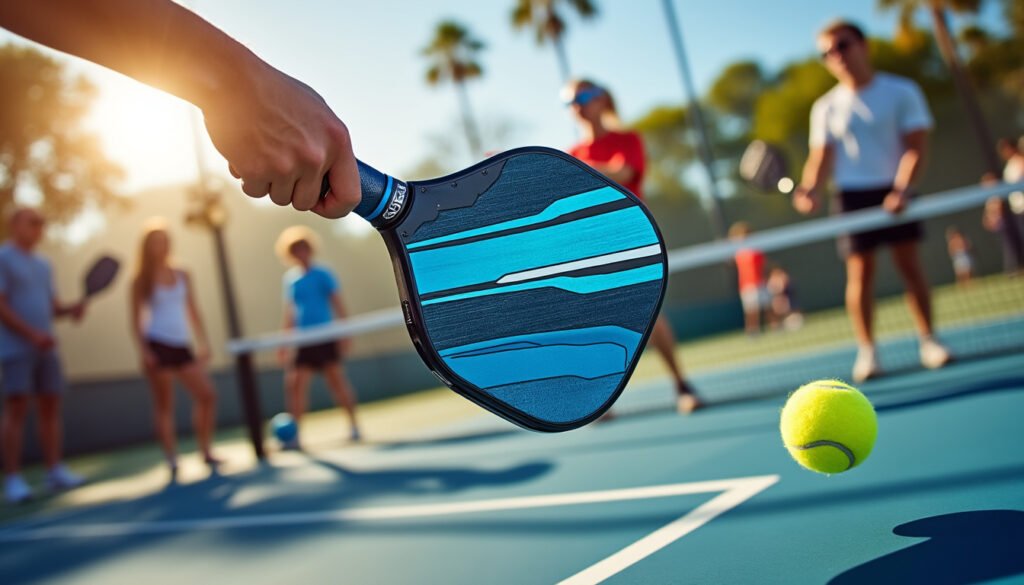
Pickleball is growing in popularity with an increase of more than 500% in players in France over the last five years 🎾. Born in the United States in the 1960s, this hybrid sport combines elements of tennis, badminton and ping-pong, making its rules simple and accessible to everyone.
Origins and growth of pickleball
This sport has quickly established itself in the global sporting landscape thanks to its ease of learning and its fun aspect. Clubs and associations are multiplying, and certain tournaments bring together more than 100 participants per meeting. A funny story tells how a passionate player managed to turn a defeat into a resounding victory in just 20 minutes during a local tournament 😮.
1. Overview of the basic rules of pickleball
Pickleball is played in singles or doubles (two players per team), although the doubles format is the most common. In both cases, the same playing area and all the basic rules apply, thus guaranteeing uniformity in the practice of the sport.
2. Pickleball serving rules
2.1. Service technology
The service is decisive for starting each point well. Here are the key elements to respect:
- The server’s arm should move in an upward arc when striking.
- The contact of the racket with the ball must not be above waist level.
- The head of the paddle should not exceed the highest part of the wrist at the time of contact.
- A drop service is permitted, in which case these constraints do not apply.
- When hitting, the server’s feet cannot touch the court or the outside of the imaginary extension of the sideline or center line. At least one foot must remain behind the baseline.
- The serve must be performed crosswise diagonally and land within the boundaries of the opposite court.
- Only one service attempt is allowed per server.
2.2. Serving sequence and return
In doubles, each team benefits from two serves before losing possession:
- Both players on the serving team may serve and score until a foul is committed (except during the first sequence of each new game).
- The first serve is from the right field.
- If a point is scored, the server changes sides and serves from left court.
- When the first server commits a fault, his partner takes over from the right side (except for the very first serve of the game).
- In singles, the server serves from the right court when his score is even and from the left court when it is odd.
- SEO Tip: At the start of each game, only one partner may serve before committing a foul, after which the service passes to the opposing team.
3. Rating and scoring system
3.1. Traditional scoring system (Side-Out)
In this system, only the points of the serving team are counted:
- Games are generally played to 11 points, with a lead of 2 points to win. For tournaments, the score can be 15 or 21 points.
- In doubles, the player who served first is positioned in the right side when the team’s score is even and in the left side when it is odd.
3.2. Rally scoring
In rally mode, a point is awarded for each rally, regardless of the serving team, making the game more dynamic and rewarding each success.
4. The two bounce rule
This rule balances the game by removing the service advantage:
- Upon serving, the receiving team must let the ball bounce before returning it.
- The serving team must also let the ball bounce when returning.
- After these two bounces, players can choose to hit the ball on the fly or after a bounce.
5. The volleyball-free zone (“the kitchen”)
To avoid smashes too close to the net, a specific zone is established:
- The no-volley zone corresponds to a distance of less than 7 feet (approximately 2.13 m) on both sides of the net.
- Volleys are strictly prohibited in this area.
- A foul is recorded if, during a volley, the player walks or his momentum causes him to enter this zone.
- A player can legally be in the kitchen as long as they do not volley.
6. Line calls
The validity of a point also depends on respecting the boundaries of the field:
- A ball touching any line (except that of the non-volley zone during a serve) is considered to be inside.
- A serve that touches the line of the non-volley zone is declared short and faulty.
7. Defects and violations
Several fouls can interrupt the game and influence the score:
- A serve that does not land within the boundaries of the receiving field.
- The ball hit into the net when serving or returning.
- The recovery of the ball on the fly before a rebound occurs in each camp.
- The ball hit out of bounds.
- Hit the ball on the fly from the no-volley zone.
- The ball bounces twice before being returned by the receiver.
- Contact with the net or post during the rally.
- A violation of the service rules (for example, not respecting the typing conditions).
- The ball hits a player, their equipment or a permanent object before bouncing.
8. Determination of the service team
To start the match, any fair method may be used to choose side, serve or receive. For example, a simple draw (by writing 1 or 2 on a score sheet) is commonly practiced.
Tips and anecdotes to progress
To improve your performance, it is advisable to vary your serves and analyze your opponents’ movements. Train regularly and observe the strategies used by professionals. An inspiring story tells of an amateur player who, thanks to rigorous discipline, went from 0 to 150 matches won in less than a year ⚡😊.
Rules and Equipment Summary Table
.responsive-table { width: 100%; overflow-x: auto; margin: 20px 0; } .responsive-table table { width: 100%; border-collapse: collapse; min-width: 300px; box-shadow: 0 2px 8px rgba(0, 0, 0, 0.1); border-radius: 8px; overflow: hidden; } .responsive-table thead { background-color: #007BFF; /* Première ligne en fond bleu */ } .responsive-table thead th { color: #fff; padding: 15px; text-align: left; } .responsive-table tbody tr { background-color: #fff; transition: background-color 0.3s ease; } .responsive-table tbody tr:nth-child(even) { background-color: #f7f7f7; } .responsive-table tbody tr:hover { background-color: #e9f5ff; } .responsive-table td { padding: 15px; border-bottom: 1px solid #ddd; } @media screen and (max-width: 600px) { .responsive-table thead th, .responsive-table td { padding: 10px; } }| Element | Rule/Description | Fact/Trivia |
|---|---|---|
| Serve | Delivered diagonally to initiate the rally | Adopted by over 80% of professional players |
| No-volley zone | 7 feet around the net to prevent fouls | Strategic zone for counterattacks |
| Score | 11-point game with a 2-point margin required | Some games can reach a score of 15-13 |
| Equipment | Specially designed racket and perforated ball | Composite rackets improve performance |
Resources and Helpful Links
To further your knowledge, it is recommended to consult reference sites in the sports field. The USA Pickleball Association provides detailed information on rules, tournaments and playing techniques 🎾. This site is an excellent resource for any enthusiast looking to improve their skills and stay up to date with the latest trends.
With these elements, you are now ready to practice pickleball with a thorough understanding of its rules and strategies. Have fun on the court and enjoy every rally with passion and determination 😊!